1995 Chrysler Concorde No Start No Fuel Injector Pulse

Engine would crank over at a normal RPM. Spark would occur then stop, (intermittent spark). There was no fuel injector pulse. Spark was tested using an HEI spark tester and injector pulse monitored with a noid light.

Once the faults were confirmed I connected my scan tool. In this case a DRB III. The scan tool confirmed my suspicion, the engine was out of sync. See arrow on photo below.
DSCN2247a
This video shows what it looks like when cranking the vehicle and viewing the sync data via scan tool data stream.

Next up was checking both cam and crank signals (synchronization) using my ATS lab scope. The pattern below shows an engine that us out of time. The arrow points to a line that depicts (about) where the cam sensor signal (green pattern) should align with the crank signal (yellow pattern)
wavea

Aligning the timing mark on the crank pulley and camshaft sprockets was the final test. The timing belt had jumped a few teeth and luckily this engine is not an interference engine. A new timing belt kit and the engine was running normally.
BMW Parasitic Closed Current Draw Specifications

Closed-circuit current consistently over 50mA should be addressed. Depending on the vehicle’s equipment, closed-circuit current by vehicle model is approximately as follows:

For BMW model and chassis designation chart go here.

E31
50 milliamps after 16 minutes

E32
50 milliamps after 16 minutes

E34
40 milliamps after 16 minutes

E36, Z3
30 milliamps after 16 minutes

E38
50 milliamps after 16 minutes

E39
40 milliamps after 16 minutes

E46
40 milliamps after 16 minutes

E60, E61, E63, E64
40 milliamps after 60-70 minutes

E65, E66
40 milliamps after 60-70 minutes

E53
40 milliamps after 16 minutes

E70, E71, E72
40 milliamps after 60-70 minutes with TCU (30 minutes without TCU)

E83
40 milliamps after 16 minutes

E82, E88
40 milliamps after 60-70 minutes with TCU (30 minutes without TCU)

E90, E91, E92, E93
40 milliamps after 60-70 minutes with TCU (30 minutes without TCU)

E85

40 milliamps after 16 minutes

E89
40 milliamps after 60-70 minutes with TCU (30 minutes without TCU)

E52
50 milliamps after 16 minutes

F01, F02, F07
7-21 milliamps after 30 minutes

Ford Easy Fuel – No Fuel Filler Cap

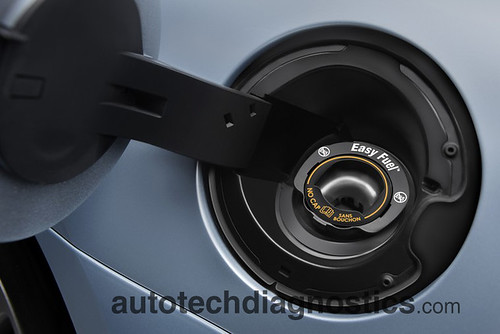
Ford’s Easy Fuel system uses an integrated spring-loaded flapper door to eliminate the need for a screw on fuel filler cap.

fusionfillerflapa

•Easy Fue capless fuel-filler system has an integrated spring-loaded flapper door that allows customers to simply insert the fuel nozzle into the tank to fill up – no screw cap is required.
•Easy Fuel automatically seals after the fuel nozzle is removed – no waiting for customers to re-secure the cap – emitting fewer evaporative emissions into the environment.
•Easy Fuel was introduced on the 2008 Ford Explorer and Mercury Mountaineer, and will be offered as standard equipment on the all-new 2009 Ford F-150, Ford Flex and Lincoln MKS.
•Ford will migrate Easy Fuel as standard across the Ford, Lincoln and Mercury passenger vehicle lineups during the next five years.

The spring-loaded flapper door is held closed by two latches that can only be released by a standard-size unleaded fuel nozzle. When the proper nozzle is inserted into the filler neck of the system, the latches release, and the nozzle pushes the spring-loaded flapper door to the open position. When the nozzle is removed, the flapper door automatically is forced closed by the spring.

flappart

The fuel filler pipe is then completely sealed, which prevents fuel vapors from escaping and helps reduce evaporative emissions.

Every time a fuel cap is either lost or not screwed on properly hydrocarbon emissions enter the environment, with Easy Fuel, this is less of a problem.

Easy Fuel also has a patented mis-fueling inhibitor to reduce improper fueling and siphoning. The inhibitor consists of a fuel nozzle detector that guides the nozzle to the opening. If a nozzle or foreign tube of a different size – a diesel nozzle or plastic hose, for example – is placed in the filler neck of a gasoline-powered vehicle, the latches will not release. For a diesel-powered vehicle, the inhibitor will keep out the smaller gasoline nozzles.

To protect the fuel filler neck from dirt, dust and debris, Easy Fuel relies on a flexible rubber seal in the body housing. The system also comes with a handy plastic funnel, which is stored with a vehicle’s tire changing kit, in case someone runs out of fuel and needs to add a gallon or two from a portable container. The funnel is the same diameter as an unleaded fuel pump nozzle for a gasoline-powered vehicle.

MINI Cooper R55, R56, P0420 – 276A Catalytic Converter Efficiency Low

R55 Cooper Clubman and R56 Cooper with N12 engine
Vehicles produced from start of production up to December 6th, 2007

Service Engine Soon lamp is illuminated and the following fault is stored in the DME memory:

276A (P0420) Catalytic-converter conversion – Catalytic-converter efficiency too low.

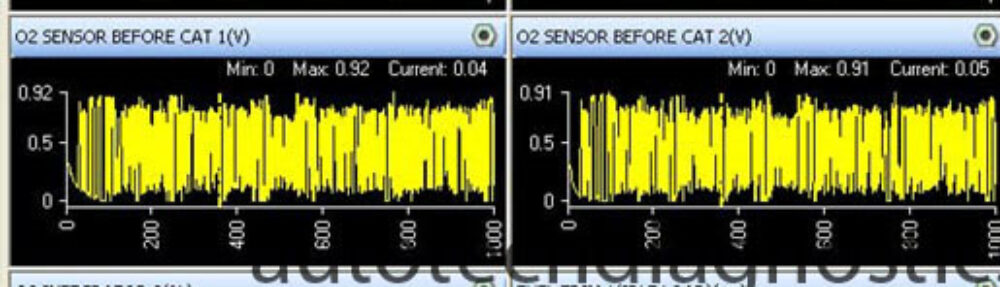
The catalytic converter may be deteriorating, causing the catalytic converter monitoring to store the above fault in the DME memory.

Covered under the terms of the MINI New Vehicle Limited Warranty or MINI Emissions Warranty

Diesel Emission DEF System Operation – 2010 EPA Regulation

Diesel Exhaust Fluid (DEF), is a solution made from 67.5% purified water and 32.5 percent automotive-grade urea that serves as a carrying agent for the ammonia needed to reduce nitrogen oxide (NOx) emissions from diesel engines. When DEF is injected into the engine exhaust gas, downstream of the DPF, it will be rapidly hydrolyzed producing the oxidizing ammonia needed by the SCR catalyst to complete NOx emissions reductions. DEF begins to freeze at 12 degrees Fahrenheit (-11 degrees Celsius), manufacturers are incorporating a heating system to prevent this.

Unlike other solutions used to control NOx, a DEF system allows the diesel engine to run at its optimum range in terms of fuel mixture – some systems require the engine to run richer, which can be harmful to diesel engines, to control the NOx.

Selective Catalytic Reduction (SCR), is a general term for aftertreatment equipment which promotes a chemical reaction by using a catalyst for eliminating or detoxifying particular chemical ingredients. To meet the EPA2010 regulation, the vehicle out NOx level will be extremely close to zero (0.2 Grams per brake horsepower). By mixing the NOx with the ammonia contained in urea, it will be separated into harmless water and nitrogen. It is an extremely effective, dependable, efficient and economical selection. SCR has already been adopted in Europe and Japan for truck and mobile vehicle applications, so it only makes sense to be used as a solution for EPA 2010. Almost every U.S. diesel engine manufacturer plans to adopt SCR technology, further proving its reliability.

How it works

The first step in cleaning the diesel exhaust occurs when the exhaust stream enters the Diesel Oxidation Catalyst (DOC). The role of the DOC is twofold. First, it converts and oxidizes hydrocarbons –
at about 250 degrees Celsius – into water and carbon dioxide.
Second, the is used to provide and promote heat, using specific engine management strategies, into the exhaust system. Through appropriate thermal management, this heat increases the conversion efficiency of the downstream subsystem(s) in reducing emissions.

The second step in the process is known as Selective Catalytic Reduction (SCR). In this process, the NOx in the exhaust stream is converted into water and inert nitrogen, which is present in the atmosphere and harmless. Before the exhaust gas enters the SCR chamber, it is dosed with Exhaust Fluid (DEF), also known as urea, an aqueous solution that is approximately 67.5 percent water and 32.5 percent pure urea.
When heated, the DEF splits into ammonia and carbon dioxide. These molecules are atomized, broken up and vaporized, then enter a mixer that resembles a corkscrew. This twist mixer evenly distributes the ammonia within the exhaust flow. The ammonia enters the SCR module, which contains a catalyzed substrate, and through chemical reactions combines and converts the NOx and ammonia into the harmless inert nitrogen and water. Dosing typically occurs between 200 and 500 degrees Celsius.

The final step of the cleansing system for the diesel exhaust gas involves the Particulate Filter (DPF). DPF traps any remaining soot, which is then periodically burned away, known as regenerating, when sensors detect the trap is full. The regeneration process sees temperatures in excess of 600 degrees Celsius to burn away soot.

MINI Cooper – Rattling Knocking Noise from Rear Axle

MINI Cooper R55,R56,R57 With sport suspension.

A rattling and/or knocking noise may be heard from the rear axle and/or rear suspension while driving over uneven roads.

The inner diameter of the stabilizer bar mounts may be too large for this application.

Use a caliper gauge to determine whether the rear stabilizer bar is 16mm (1) (non-sports suspension). If the stabilizer bar is 16mm, replace the stabilizer mounts (2) with P/N 33 55 6 754 823.
bar

6 Series BMW E63, E64 Bulb Out Warning

E63, E64 (6 Series)
from 9/2007
• Bulb out warning in
Check Control
• FC A8BE or A8BF
(BFD) is stored in
the lamp module

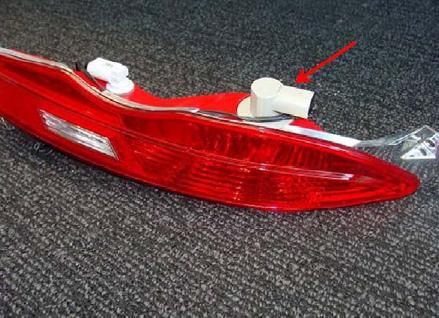
Although installed in the vehicle, this bulb is not used for US vehicles, but the circuit is still monitored with the Check Control. For non-US vehicle, the bulb is used as a rear fog lamp.

bulb

There is a bulb in lower rear lamp
• Bulb not shown in wiring diagram
• Replaceable bulb not shown parts catalog

location

Replace bulb if found to be faulty. Confirm all wiring is intact and working properly.

1996 Nissan Maxima 3.0 P0105 P1105

Both fault codes point to the absolute pressure sensor. The absolute pressure sensor is connected to the MAP / BARO switch solenoid valve by a vacuum hose. The sensor detects ambient barometric pressure and intake manifold pressure and sends a voltage signal to the ECM. As pressure increases, voltage rises. The sensor is not used as an input to control the engine management system. It is used only for on-board diagnosis. Therefore you can have fault codes with no drivability complaint.

You can see both the sensor and switching solenoid have been replaced. The fault codes remained.

dscn2823

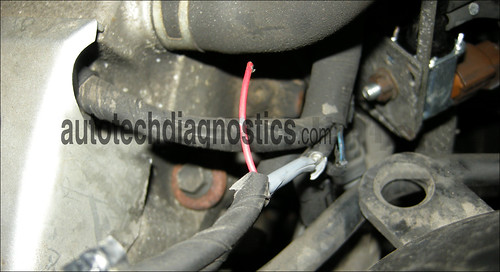
I went directly to the sensor to backprobe the connector with the key ON and engine OFF. The first wire I tested was the 5 volt reference. The reading I obtained was 4.35 volts. Too low for a 5 volt reference. I wiggled the harness and the voltage changed accordingly. Next I cut the harness sheathing back to reveal damaged wires. 1 completely broken and the others with broken insulation. The harness to the sensor has a very sharp bend in it. Over time the wires degraded and finally failed. A quick harness repair and the fault codes were gone.

dscn2827

BMW Chassis Model E Designation Chart

E28 5 Series 524td, 528e, 533i, 535i, 535is, M5 82 – 88
E30 3 318i, 318is, 325, 325e, 325es, 325i, 325is, 325iC, 325ix, M3, Z1 84 – 91
E31 8 840Ci, 850i, 850Ci, 850CSi 90 – 99
E32 7 735i, 735iL, 740i, 740iL, 750iL 88 – 94
E34 5 525i, 530i, 535i, 540i, M5, Touring 89 – 96
E36 3 318i, 318is, 318ti, 325i, 325is, 325iC, 328i, 328is, 328iC, M3, Z3 92 – 99
E38 7 740i, 740iL, 750iL 95
E39 5 528i, 540i 97
E46 3 323i, 325i, 328i, 323Ci, 328Ci, M3 99
E53 5 X5 3.0, X5 3.0d, X5 4.4, X5 4.6is 00
E65 7 745i 02

Posted in BMW